Seguro de vida inteira
Para ajudar seu amigo Ethan, que está estudando para o exame atuarial, Cynthia quer criar um código em R que calcule o VPE de um seguro de vida (inteira) sobre \((x)\) para uma dada taxa de juros constante \(i\). Como os benefícios por morte são constantes em 1 EUR, você não precisa considerá-los explicitamente nos cálculos.
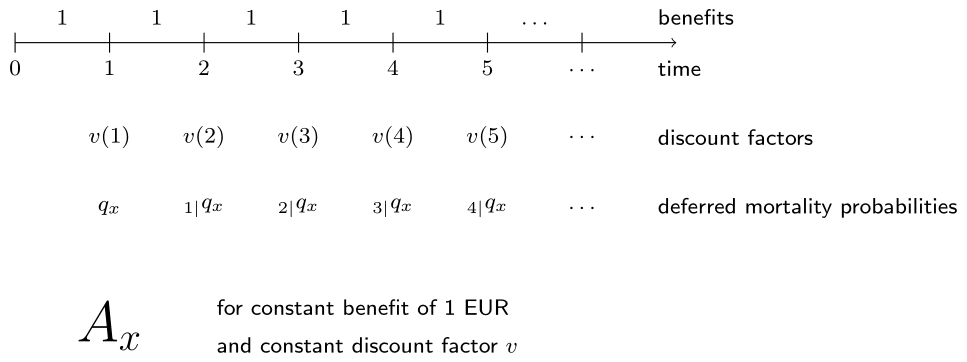
A tábua de vida de mulheres da Bélgica de 1999 já está carregada como life_table. As funções plot_by_age() e plot_by_interest_rate() foram predefinidas para ilustrar como o VPE varia com a idade \(x\) da pessoa segurada e com a taxa de juros. Você pode inspecionar essas funções digitando o nome delas no console do R.
Este exercicio faz parte do curso
Avaliação de Produtos de Seguro de Vida em R
Instruções do exercicio
- Complete a função
whole_life_insurance()que calcula o VPE de um seguro de vida inteira para umaagedada, taxa de jurosielife_table. - Execute o código predefinido para plotar o VPE de um seguro de vida inteira para um intervalo de idades (com taxa de juros de 3%) e um intervalo de taxas de juros (para alguém de 20 anos). Interprete os gráficos resultantes.
exercicio interativo prático
Tente este exercicio completando este código de exemplo.
# Function to compute the EPV of a whole life insurance
whole_life_insurance <- function(age, i, life_table) {
  qx <- life_table$qx
  px <- ___
  kpx <- c(1, cumprod(px[(___):(length(px) - 1)]))
  kqx <- kpx * qx[(___):length(qx)]
  discount_factors <- (___) ^ - (1:length(kqx))
  sum(discount_factors * kqx)
}

# Plot the EPV of a whole life insurance for a range of ages at interest rate 3% using life_table
plot_by_age()

# Plot the EPV of a whole life insurance for (20) for a range of interest rates using life_table
plot_by_interest_rate()