Binomiale verdeling
In de vorige oefening heb je de Bernoulli-proeven gemodelleerd. De binomiale verdeling is de som van het aantal successen in een reeks Bernoulli-proeven.
De notatie van de binomiale verdeling is \(B(n, p)\), waarbij \(n\) het aantal experimenten is en \(p\) de kans op succes.
Voor deze oefening bekijken we 10 opeenvolgende eerlijke muntworpen. Je hebt op koppen ingezet en beschouwt dit resultaat van een muntworp als een succes.
Onthoud dat:
dbinom(x = k, size = n, prob = p)\(P(X = k)\) berekent voor \(X \sim B(n, p)\),pbinom(q = k, size = n, prob = p)\(P(X \le k)\) berekent voor \(X \sim B(n, p)\).
Denk eraan dat voor discrete verdelingen die gehele getallen aannemen geldt: \(P(X \ge k) = 1 - P(X \le k-1)\).
Bijvoorbeeld:
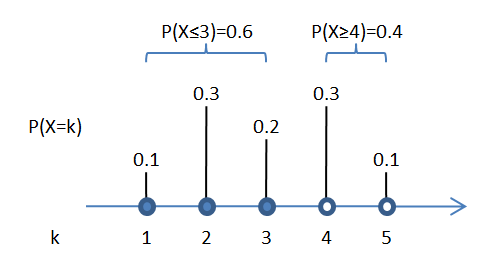
Dus, \(P(X \ge 4) = 1 - P(X \le 3)\).
Deze oefening maakt deel uit van de cursus
Oefenen met statistiek-vragen voor sollicitaties in R
Oefeninstructies
- Ken de kans op precies 6 koppen toe aan
six_tailsen print het resultaat. - Ken de kans op 7 of minder koppen toe aan
seven_or_lessen print het resultaat. - Ken de kans op 5 of meer koppen toe aan
five_or_moreen print het resultaat.
Interactieve oefening met praktijkervaring
Probeer deze oefening door deze voorbeeldcode aan te vullen.
# The probability of getting 6 tails
six_tails <- ___(___ = ___, size = ___, prob = ___)
print(six_tails)

# The probability of getting 7 or less tails
seven_or_less <- ___(___ = ___, size = ___, prob = ___)
print(seven_or_less)

# The probability of getting 5 or more tails
five_or_more <- 1 - ___(___ = ___, size = ___, prob = ___)
print(five_or_more)