用梯度做优化
给定一个损失函数 $y = x^{2}$,目标是将其最小化。您可以在不同的 x 取值处,使用 GradientTape() 运算计算斜率。如果斜率为正,通过减小 x 可以降低损失;如果斜率为负,通过增大 x 可以降低损失。这就是梯度下降的工作原理。
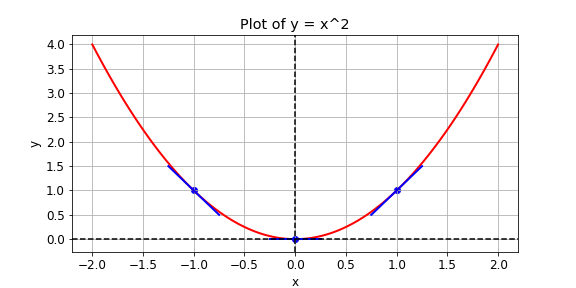
在实际应用中,您会使用高层的 tensorflow 运算自动执行梯度下降。不过在本练习中,您将分别在 x 为 -1、1 和 0 时手动计算斜率。可用的运算有:GradientTape()、multiply() 和 Variable()。
本练习是课程的一部分
Python 中的 TensorFlow 入门
练习说明
- 将
x定义为初始值为x0的变量。 - 将损失函数
y设为x乘以x。不要使用运算符重载。 - 使函数返回
y关于x的梯度。
交互式实操练习
通过完成这段示例代码来试试这个练习。
def compute_gradient(x0):
  	# Define x as a variable with an initial value of x0
	x = ____(x0)
	with GradientTape() as tape:
		tape.watch(x)
        # Define y using the multiply operation
		y = ____
    # Return the gradient of y with respect to x
	return tape.gradient(____, ____).numpy()

# Compute and print gradients at x = -1, 1, and 0
print(compute_gradient(-1.0))
print(compute_gradient(1.0))
print(compute_gradient(0.0))